Sunday, March 19, 2017

TOW #23 - Pilots' Confidence

Many pilot only manually control their plane for a couple minutes each flight. The rest of the time is spent monitoring the autopilot system. However, without the autopilot, many pilots feel unconfident in their flying ability. They rely so much on the system that when it crashes, the plane typically ends up crashing too.
The author, David Learmount, writes an essay arguing for the probable cause of the AirAsia flight QZ8501’s crash. He believes that the crash occurred because of the pilot’s self confidence, not because of the plane itself. To support this argument, he uses 3 similar plane crash stories. He also uses a study that was done about pilots to explain how pilots rely on their autopilot system.
The first story was of an Air Algerie flight that went missing after a change in course. The second story was of an Air France flight that’s black box revealed that the pilots were given control from the autopilot, but they lost control of the plane without having an autopilot to help them. The third story was of a West Caribbean Airways that went out of control after the pilots flew the plane too low. However, there was nothing wrong with the plane, if the pilots had had practice without their computers, they would have been able to lift the plane more and saved their passengers. In every story, with more training, the pilot could have saved the flight.

By comparing these stories to the story of the AirAsia flight, one can see that the similarities point to a common cause. The evidence strongly suggests that the pilot’s training is at fault, instead of the plane or the weather. With this evidence, one can see that more training is necessary in having safe flights.

Sunday, March 12, 2017

TOW #22 - Muckrakers

The living conditions for immigrants during the early 1900’s was horrible. Many people were dying of disease, poor, and had harsh work hours. Upton Sinclair wrote a book to expose to the American public how horrid the life of an immigrant was. However, he described the lack of proper sanitation of the meatpacking industry in too much detail, leading to the American public demanding change for their food, but not for immigrants. President Roosevelt did pass acts that changed the meatpacking industry, however was angry that, he believed, Sinclair exaggerated the conditions of the meatpacking companies.
Theodore Roosevelt, the 26th president of the United States, wrote “The Man with the Muckrake” which is a speech about journalists. He targeted journalists, especially Sinclair, that over exaggerated what they were reporting, and ultimately hurt the companies they were bad-mouthing. He calls them muckrakers because they focus on the muck of the story. In today’s world, Roosevelt would be incredibly unhappy with how manipulative the media can be.
In everyday life, one can tweet about someone else and create a false rumor. Regardless of the validity of the rumor, the existence of it itself can cause the person that was tweeted great stress; it can make someone seem bad regardless of whether they actually are or not. On a larger scale, a bad review can cost a company customers even if the company did not earn that review. Comparably celebrities can lose fans over false rumors.
All over the world, journalists hold a special ability. Through their words, they can expose bad companies to the public. They can cause real harm to companies that are causing harm in their own way. However, they can also cause harm to fair businesses. Rumors hold enough weight in today’s world to not need facts to support them. The rumor itself can destroy a person or business’s credibility, even if it is completely false. Through writing lies, journalists today can spread the word quickly about a company and have it shut down the next day.
Roosevelt wanted to prevent mudslinging to occur. He wanted companies to be treated fairly if they acted fairly. However, in the world that we are in today, media plays such a huge role that it can really hurt businesses. Roosevelt would disagree with the way that media is used, and would beg people to stop acting like the muckrakers from the early 20th century.

Sunday, March 5, 2017

TOW #21 - By Gum


To what extent do you agree or disagree with the author’s central claim?

During the late 1800’s America entered the Age of Imperialism. With it came a thirst for overseas expansion, leading to the admittance of Hawaii as a part of the united states. Another addition to the united states, although not permanent, was the Philippine Islands. The United States won a war with the Spanish and ultimately gained control of Cuba, Puerto Rico, and the Philippines. President McKinley decided to maintain control of the Philippines, even though the Filipinos were not given rights as American citizens.
In this political cartoon, Uncle Sam, the representation of America, is playfully putting American flags across the globe. He is casually smoking a cigar whilst selecting areas for the United States to conquer. By saying “By gum, I rather like your looks” he is expressing how much he likes American imperialism. However, this portrayal of Uncle Sam shows the dark side of imperialism. Uncle Sam is being very casual in deciding where America will grow to; ultimately he shows how Americans wanted to expand to expand and they wanted to win other territories because they liked their looks, not because they wanted to help the other countries.

I agree with the author’s central claim that America during the Age of Imperialism was being too casual with the imperialistic powers it had. For example McKinley claimed that by controlling the Philippines he would help the Filipinos, but life for the Filipinos was worse under American control than before. He also decided to keep the Philippines because he said that God wanted him to, not because of political reasons. Making a decision based off of religion is not fair to do while president of a country free of religious tyranny because there is supposed to be a separation of church and state. Finally, America did not need to help the Philippines, they could have granted the Filipinos independence and let the country run on its own, but America instead casually played with a country and took leadership of it, not considering the drastic effects on the actual inhabitants of the territory.

Sunday, February 26, 2017

TOW #20 - Killing the Rising Sun

Killing the Rising Sun, by Bill O’Reilley, recounts the horrors of war before the decision to drop the atomic bombs that lead to Japanese surrender and soon after an end to the war. However, it is still hotly argued today whether the decision was right. Even though it did end the war, it lead to the death of almost 200,000 Japanese citizens. The majority of the beginning of the book recounts terrifying stories at war - men lying on grenades to save the rest of the Americans in that area, the ways prisoners of war were treated, and many other details that are hard to stomach. However, I think that these stories were necessary in creating the author’s argument that the atomic bombs needed to be dropped.
The book begins with a detailed description of Corporal Lewis Kenneth Bausell and his American peers. Peleliu, where the Americans want to protect from Japanese invasion, is described as “a living hell.” (10). O’Reilley then spends close to 40 pages describing the hell-like stories that came from Peleliu. Although these pages are hard to read, they give the audience a glimpse of life during war. That perspective is an important part of the book because it helps the audience realize that prolonging war was absolutely awful for the soldiers who fought.
These stories also serve as an interesting hook to the book. They give the readers insight to something that most of the audience has not experienced. That hook may also helps the audience feel interested to read about the decision to end the war through the dropping of the atomic bomb after seeing what the atomic bomb would be stopping.
The stories also create an appeal to pathos through narrative, which helps the audience agree with O’Reilley and the decision to drop the bombs. Although I have not finished the book nor decided whether I disagree or agree yet, the audience may feel more inclined to after finishing the book understand the decision of the atomic bomb drop.

Overall, the stories create an interesting dynamic to the book that would be missing a lot of emotion without these stories. The narratives serve to add perspective for the audience, create a strong hook, and appeal to pathos, which make the book overall better.

Monday, February 20, 2017

TOW #19 - American Flag

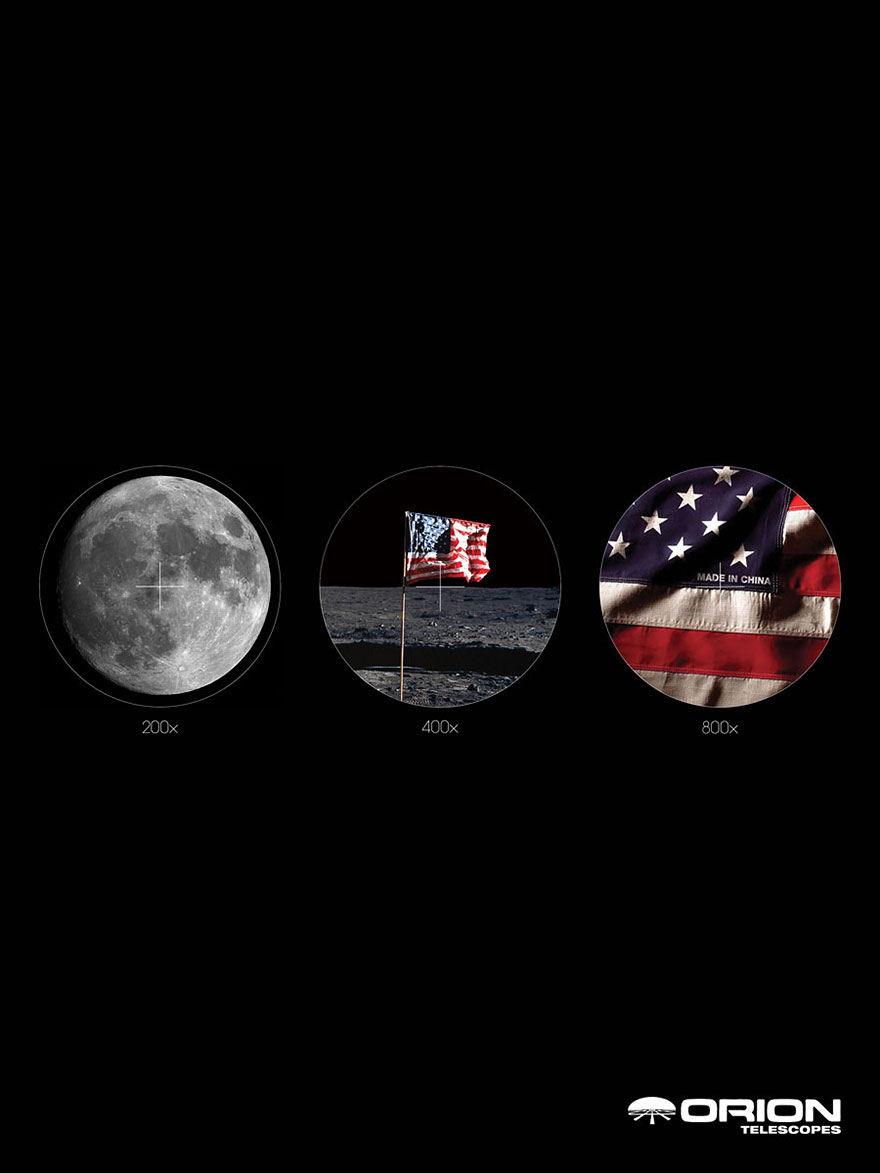
One of America’s biggest accomplishments was landing on the moon and putting an American flag on the surface of the moon. However, to see that flag, one would need a really quality telescope. Orion, a telescope company, used this idea to create a creative advertisement for their telescopes.
The text was composed for potential buyers of the telescopes. The author juxtaposes pictures together to create a humorous effect. The author juxtapositions views that the Orion telescope can show. The first is a picture of the moon, the second is a picture of the American flag and the third is a picture of the American flag’s label “Made in China.” These pictures are all very clear, showing that the telescope will give off clear images, even when zoomed in an extreme amount. There is an element of humor that is also used in the advertisement. By having an American flag say “Made in China” on the moon, the advertisers are saying that even one of America’s biggest accomplishments was not fully their own. The advertisers make fun of Americans for their use of products that are not American, but in a playful way that will make their audience laugh and not be offended.
The author’s purpose in creating the advertisement was to get their audience to buy the telescope. The author probably did get more people to buy their telescopes because it is not only a funny picture, but it also displays the clearness of the telescope.

Sunday, February 12, 2017

TOW #18 - Argument Against Homework

In “The growing argument against homework,” David McGinn, a journalist for The Globe and Mail, writes about why young students should not have to do homework. He explains that homework does not have many benefits, but it does cause frustration and exhaustion, leading to a lack of interest in learning.
I agree with the author’s argument, however I think that he could have applied the argument to high schoolers as well; he also used other methods of argumentation than appeals to logos.
The main argument focuses on a New York elementary school’s ban on homework. He agrees with the ban, but his argument surrounds the idea of a homework ban on elementary school students. However, I think that homework has even worse of an effect on high school students, including a lack of sleep and extreme stress. I think that his argument should also apply to older students to reach a wider audience and have more of an impact on his audience. I also think that elementary school students are not as impacted by a lot of homework because they typically have more freetime than high schoolers.
He explains that parents are upset with a New York school’s recent ban on homework, but argues with statistics that it is good for the students to have a break from homework. I agree with his argument, but I think that if he incorporated more pathos into his argument he could have parents understand that homework can be emotionally draining in addition to not helping the student’s education.
Ultimately, I agree with David McGinn, however I think that there are a couple of improvements that he could make to his argument to catch a principal’s attention and force a change in education systems.

Wednesday, February 8, 2017

IRB Intro Post #3

Killing the Rising Sun is a book that reveals the details behind the decision to drop the atomic bomb. I decided to read this book as my IRB because my dad recommended it and I have a strong interest in history and World War II.