Sunday, February 26, 2017

TOW #20 - Killing the Rising Sun

Killing the Rising Sun, by Bill O’Reilley, recounts the horrors of war before the decision to drop the atomic bombs that lead to Japanese surrender and soon after an end to the war. However, it is still hotly argued today whether the decision was right. Even though it did end the war, it lead to the death of almost 200,000 Japanese citizens. The majority of the beginning of the book recounts terrifying stories at war - men lying on grenades to save the rest of the Americans in that area, the ways prisoners of war were treated, and many other details that are hard to stomach. However, I think that these stories were necessary in creating the author’s argument that the atomic bombs needed to be dropped.
The book begins with a detailed description of Corporal Lewis Kenneth Bausell and his American peers. Peleliu, where the Americans want to protect from Japanese invasion, is described as “a living hell.” (10). O’Reilley then spends close to 40 pages describing the hell-like stories that came from Peleliu. Although these pages are hard to read, they give the audience a glimpse of life during war. That perspective is an important part of the book because it helps the audience realize that prolonging war was absolutely awful for the soldiers who fought.
These stories also serve as an interesting hook to the book. They give the readers insight to something that most of the audience has not experienced. That hook may also helps the audience feel interested to read about the decision to end the war through the dropping of the atomic bomb after seeing what the atomic bomb would be stopping.
The stories also create an appeal to pathos through narrative, which helps the audience agree with O’Reilley and the decision to drop the bombs. Although I have not finished the book nor decided whether I disagree or agree yet, the audience may feel more inclined to after finishing the book understand the decision of the atomic bomb drop.

Overall, the stories create an interesting dynamic to the book that would be missing a lot of emotion without these stories. The narratives serve to add perspective for the audience, create a strong hook, and appeal to pathos, which make the book overall better.

Monday, February 20, 2017

TOW #19 - American Flag

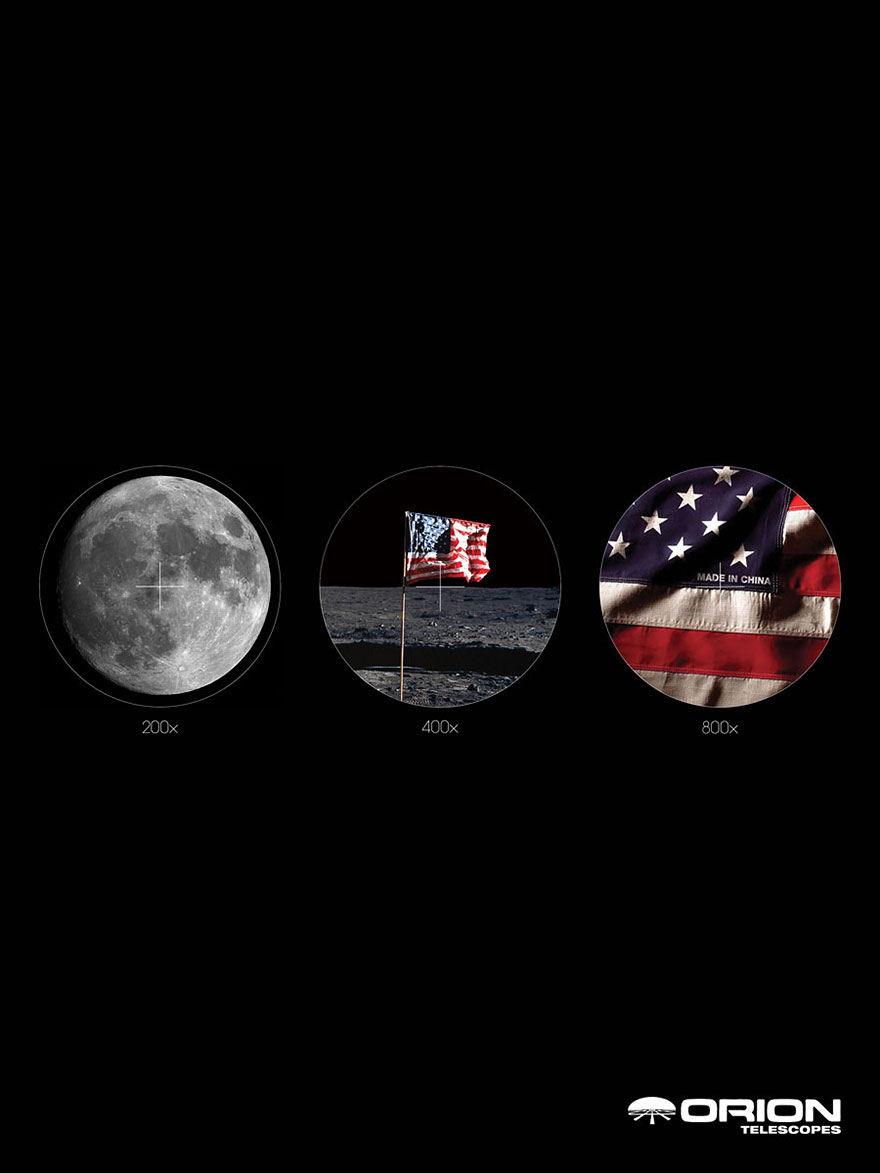
One of America’s biggest accomplishments was landing on the moon and putting an American flag on the surface of the moon. However, to see that flag, one would need a really quality telescope. Orion, a telescope company, used this idea to create a creative advertisement for their telescopes.
The text was composed for potential buyers of the telescopes. The author juxtaposes pictures together to create a humorous effect. The author juxtapositions views that the Orion telescope can show. The first is a picture of the moon, the second is a picture of the American flag and the third is a picture of the American flag’s label “Made in China.” These pictures are all very clear, showing that the telescope will give off clear images, even when zoomed in an extreme amount. There is an element of humor that is also used in the advertisement. By having an American flag say “Made in China” on the moon, the advertisers are saying that even one of America’s biggest accomplishments was not fully their own. The advertisers make fun of Americans for their use of products that are not American, but in a playful way that will make their audience laugh and not be offended.
The author’s purpose in creating the advertisement was to get their audience to buy the telescope. The author probably did get more people to buy their telescopes because it is not only a funny picture, but it also displays the clearness of the telescope.

Sunday, February 12, 2017

TOW #18 - Argument Against Homework

In “The growing argument against homework,” David McGinn, a journalist for The Globe and Mail, writes about why young students should not have to do homework. He explains that homework does not have many benefits, but it does cause frustration and exhaustion, leading to a lack of interest in learning.
I agree with the author’s argument, however I think that he could have applied the argument to high schoolers as well; he also used other methods of argumentation than appeals to logos.
The main argument focuses on a New York elementary school’s ban on homework. He agrees with the ban, but his argument surrounds the idea of a homework ban on elementary school students. However, I think that homework has even worse of an effect on high school students, including a lack of sleep and extreme stress. I think that his argument should also apply to older students to reach a wider audience and have more of an impact on his audience. I also think that elementary school students are not as impacted by a lot of homework because they typically have more freetime than high schoolers.
He explains that parents are upset with a New York school’s recent ban on homework, but argues with statistics that it is good for the students to have a break from homework. I agree with his argument, but I think that if he incorporated more pathos into his argument he could have parents understand that homework can be emotionally draining in addition to not helping the student’s education.
Ultimately, I agree with David McGinn, however I think that there are a couple of improvements that he could make to his argument to catch a principal’s attention and force a change in education systems.

Wednesday, February 8, 2017

IRB Intro Post #3

Killing the Rising Sun is a book that reveals the details behind the decision to drop the atomic bomb. I decided to read this book as my IRB because my dad recommended it and I have a strong interest in history and World War II.

Sunday, February 5, 2017

TOW #17 - Snapchat

In the Wall Street Journal, Christopher Mims published an article called, “Why Snapchat Is the New TV.” In his article, he argues, surprisingly, that Snapchat is the new TV. His argument is supported by the ideas that Snapchat is a way to spread information quickly, it’s used as a leisurely activity, and has millions of users everyday. Although all of that information is true, I do not agree that it will replace TV.
Snapchat is a way to quickly spread information, however most people do not go to Snapchat as their main source of news. They tend to stick with the news on the TV or online websites like CNN. The news on Snapchat does not provide as much information as TV or online sources. Snapchat is also mainly used for contacting friends, not finding out what is happening around the world.
Mims also argues that Snapchat is a leisurely activity, like watching TV. However, dissimilar to watching TV, in my experience as an avid Snapchat user, most users spend about 5 minutes on Snapchat at a time. I would not sit on my couch for hours watching stories or contacting friends, but it’s a lot easier to spend hours watching movies or TV shows.
Finally, Mims uses the argument that Snapchat has a very wide audience so it is similar to TV. However, Snapchat mainly has teenagers who watch stories or read its news, and older adults tend to stray from Snapchat. However, almost every age feels comfortable using a TV. The TV has a much broader audience and larger audience as it reaches people through multiple companies, Netflix, Hulu, and many other ways to spread information.
Christopher Mims creates a strong argument for why Snapchat is the New TV, however I disagree with his argument. I do think that his message, that Snapchat is important and rapidly increasing its audience, is well supported through his argument.

Sunday, January 22, 2017

TOW #16 - The Glass Castle

The second half of The Glass Castle describes Jeannette Walls’ life during middle school and beyond. She moves to New York City with her sister after she graduates. She sees her parents on occasion until her sister gets arrested for stabbing her mom. Her dad dies from a heart attack, and the book ends describing Thanksgiving dinner 5 years after her father’s death.
Jeannette Walls is a credible author, as her instant ethos was established through the story being about her life. The Glass Castle may be written for people who are struggling with their familial lives. The text was written after seeing her (homeless) mom in New York City, reminding her of her childhood.
Walls uses many rhetorical devices. Some of the ones that she uses includes symbolism and irony. Walls uses symbolism with her boyfriend and her family. Her first husband is, “a man who was exactly the opposite” of her dad (268). She later divorces her husband and marries someone who was “more right” for her. This divorce shows that she doesn’t need someone who is exactly the opposite of her dad, because there were some good aspects of her dad that she loved. Just as in every family there are good aspects that are loved. Walls uses irony with her mother’s land. For Walls’ entire life, her parents were poor. They moved around and barely survived. However, Walls later finds out that her mom owned about $1 million in land. The irony is that her mother had all of this money, but was unwilling to use it because getting the money would mean selling the land. If she sold the land, she would be giving up a familial tradition. However, if she used the money, she would be helping her family.
I think that the author wants to show that there is balance between “turbulence and order” (288). She loved her parents even though they were extremely free to the point of being dangerous, because her family found a balance between freedom and danger. She believes that her family, no matter how crazy, was good. She loves her family, and no matter what could not abandon them. Her purpose may be to try to reach out to other families and remind them that familial love is unbreakable. I think that she did accomplish her purpose because she uses her own life to explain how much she loved her family, even though she had a lot of reason to resent her parents.


Monday, January 16, 2017

TOW #15 - Or Drink And.


Ever since we were little students have been hearing about the negative effects of drinking and driving. Many programs are utilized to prevent alcohol-induced accidents. These programs tend to use a scare tactic, which shows the terrifying aspects of one bad decision, and hopes to scare people from performing such actions. Research suggests that shock tactics do work, but they need to be targeted and followed by strong enforcement of driving laws. This advertisement is a perfect example of the scare tactic that advertisers use.
This text was created by Abramet to prevent drunk driving. Abramet published the text, which is the Brazilian Association of Traffic Medicine. The text was composed for any kind of driver, hoping to remind them to not get behind the wheel after consuming alcohol or drugs. The text was written because there are many drug and alcohol related car accidents.
The text uses symbolism and tone to create a powerful image. The can symbolizes a car after the driver has been drinking. The can is crushed symbolizing it is empty, which means that the drinker was drinking. The car is also crushed to show that when one drinks and drives, they have a high chance of getting into an accident.
The text also uses tone in their picture. The colors are all dark and negative, which goes along with a gloomy tone. If the text had bright colors, the message would not be as powerful. But by having dark colors, the text effectively shows how drinking and driving is a bad decision that will not end well.

The author created this text to attempt to stop drivers from driving under the influence. The author uses a scare tactic to show the negative impacts that drinking and driving have. The caption is “You can drink and drive. Or drink and.” The incomplete sentence suggests that the driver would not drink and drive, but drink and crash and not be able to finish his drive.  I think this picture is extremely powerful in showing the effects of drinking and driving. It has a powerful and uses a scare tactic well to remind drivers to only drive sober.